Does non-woven fabric have elasticity?
2026-01-06
The elasticity of nonwoven fabrics refers to a physical property of the material that allows it to return to its original shape after being stretched. It's important to note that elasticity is not an inherent property of nonwoven fabrics, but rather determined by its raw materials, manufacturing process, and structural design.

Generally, traditional nonwoven fabrics have a relatively stiff texture and limited stretch recovery. However, by selecting specific fibers, adding elastic components, or adjusting the production process, nonwoven fabrics can be given varying degrees of elasticity.
I. Main Factors Affecting Nonwoven Fabric Elasticity
1. Fiber Type
Synthetic fibers (such as polyester and polypropylene) can be engineered to produce nonwoven fabrics with unidirectional or bidirectional stretch.
Natural fibers (such as cotton) have inherently weak elasticity, but their extensibility can be improved by blending or compounding them with elastic fibers.
2. Manufacturing Process
Mechanical entanglement (such as spunlace and needlepunching): The fibers are loosely bound together, potentially exhibiting some elasticity.
Thermal bonding: The fibers are tightly bound together after heat melting, usually resulting in lower elasticity, but its stretchability can also be controlled through process adjustments.
3. Fabric Density
High-density nonwoven fabrics have a tight structure and generally poor elasticity; low-density nonwoven fabrics have a looser fiber arrangement and often possess better stretching capabilities.
High-density nonwoven fabrics have a tight structure and generally poor elasticity; low-density nonwoven fabrics have a looser fiber arrangement and often possess better stretching capabilities.

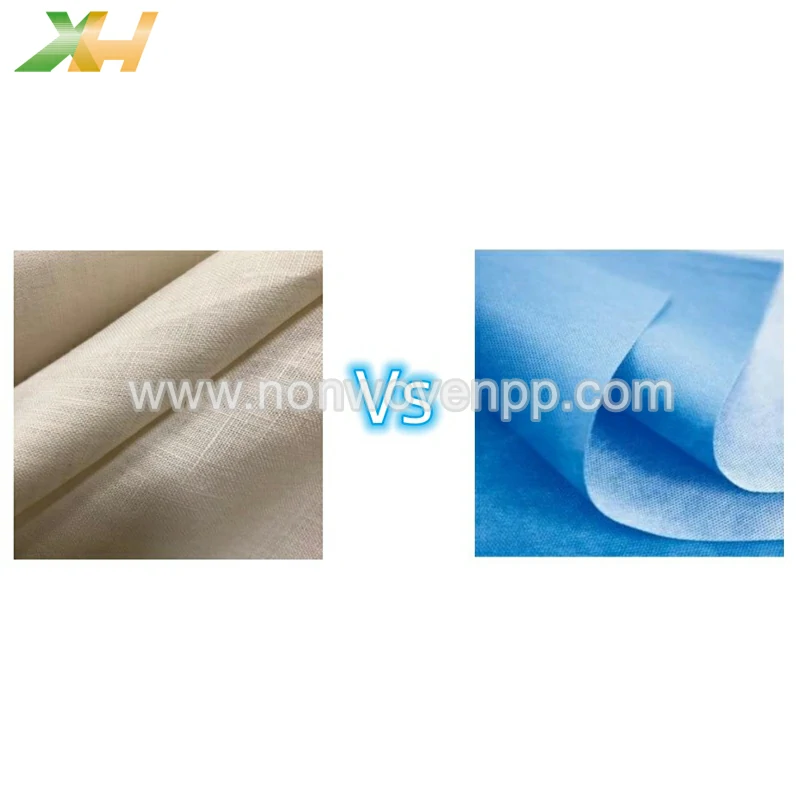
II. Comparison of Elastic and Non-Elastic Nonwoven Fabrics
Non-Elastic Nonwoven Fabrics
These are mostly manufactured using mechanical, thermal, or chemical bonding processes, resulting in a stable structure and high strength, making them suitable for applications requiring high shape retention.
Elastic Nonwoven Fabrics
These achieve stretch and recovery through the incorporation of elastic fibers, the addition of elastomers, or the use of special processes. They are commonly used in products requiring close fit, wrapping, or dynamic use.
These achieve stretch and recovery through the incorporation of elastic fibers, the addition of elastomers, or the use of special processes. They are commonly used in products requiring close fit, wrapping, or dynamic use.
III. Summary
Whether a nonwoven fabric possesses elasticity depends on multiple factors, including the fiber material, manufacturing process, structural density, and functional design. Understanding these influencing factors helps in selecting the most suitable type of nonwoven fabric based on specific application requirements (such as conformability, recovery, and durability).
For further information or to select nonwoven fabrics with specific elasticity, please feel free to contact us. We will provide you with professional product support and solutions.

Three common types of non-woven fabrics
How to identify non-woven fabric?